IPB
IPB

Welcome Guest ( Log In | Register )


Quick Search

This Article
Article Options

. View Revisions
. Watch this article

Article Rating

Rating: 4 ( 3 total votes )

Article Information


Created by:
SCC
Jul 11 2007, 09:54 AM

Last edited by:
Allerka
Aug 28 2008, 06:45 AM

Views: 5332


Index Astartes: Lords of Oblivion
This article has been viewed 5332 times.
Index Astartes: Lords of Oblivion


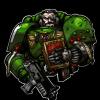
Lords of Oblivion Battle-Brother
(Note 1st Tactical Squad and 3rd Company markings)
"Then come, beast. Come with all your legions of daemons, and heretics, and traitors. We will not cower before you, and we shall stand fast against everything you throw at us until the end of time."
-High Paladin Allerka, as he stood over the shattered body of K'laernik, Lord of Change, at the end of the Salvation of Firien campaign.

Origins
During the Great Crusade, the world of Firien was one of the first worlds reclaimed by the newly born Imperium. The forces of the Emperor found a peaceful world, which happily accepted the rule of the Emperor. Remarkably, the planet had been completely unscathed in the centuries following the Age of Strife. From what the Imperial forces could discern, the humans of Firien had peacefully co-existed with an alien species, called the Dremori, and together they fended off any attacks from marauding pirates or invaders. However, nearly two hundred years prior, the Dremori simply vanished, and hadn't been heard from since.

With the planet integrated into the new Imperium, the Great Crusade continued on, and the inhabitants of Firien resumed their lives, occasionally sending what supplies and men they could to help fight in the Great Crusade, but otherwise doing nothing of note.

However, once the Horus Heresy erupted, and the fleets of Horus made their way to Terra, they had to pass through the Firien system as one of their last stops. Terrified of the vast armada passing through, the inhabitants of Firien did nothing to stop the advance of Horus' fleet, save for a few stubborn soldiers who threw themselves at the armada, only to be crushed like flies. Fortunately for Firien, the forces of Horus were too eager to reach Terra, and thus decided not to waste their time with them.

Before long, Terra came under siege, and the final battle between Horus and the Emperor was fought. Learning of what happened to the Emperor, the people of Firien became wracked with guilt and distress. Thousands committed suicide. If they had done more to stop Horus, if they had stood and fought, rather than cower in fear, even if they didn't stop Horus, perhaps they could have at least bought a little more time for the other Space Marine Legions to arrive and lend their aid to the fight.

The culture of Firien underwent extreme changes in the following centuries. Never again would they be found wanting when the call to arms comes. In the flames of their repentance, they forged a new society based on honor, duty, and the good of all humanity going above one's personal desires.

Before long, the Imperial Guard began tithing its citizens for its armies. These Terran Imperial Guard (they began to call themselves Terrans, to symbolize Terra being their true homeworld, and as a gesture of a respect for the Emperor) soldiers became renowned for their tenacity and ferocity in battle, going above and beyond anything that was expected of them.

Seven thousand years later, the Lords of Oblivion were brought into existence in this society. It was decided the people of Firien would be ideal candidates for Space Marines. Like so many things in the Imperium, their exact origin, and details such as who ordered the founding, are unknown. It is only known that a Chapter of Space Marines was created to be stationed in the heart of the Segmentum Solar to counter rising concerns of Ork and Hrud raiders.

The gene-seed of the Iron Hands was chosen for the Chapter, as it was reasoned that the strength of will and character the Iron Hands and their Successors are known for would be an ideal match with the zealous nature of Firien's populace. A portion of Castellum Acies, a massive castle located in the heart of Firien's capital city, was renovated and converted to be the Fortress-Monastery of the Lords of Oblivion.

After a century of organizing and manufacturing the gear needed, the Lords of Oblivion set off for their first campaign, to counter an Ork Waaagh! which had just entered Imperial space in the Balmoran Cluster.

Within five hundred years of service, the threats the Lords of Oblivion had been created to battle had been completely eradicated. In search of new foes, they set forth from the Segmentum Solar, and have battled every kind of enemy imaginable in the millennia since. From the Halo Stars to the Eye of Terror to the Eastern Fringe, the Lords of Oblivion have engaged in battle on hundreds of worlds.


Major Campaigns
Chapter Symbol
The Balmoran Cluster: A series of systems strung across the outer edges of a vast nebula, the worlds of the Balmoran Cluster were valued for the vast amounts of raw gaseous materials that were mined in orbit around them. However, in 912.M38, the Ork warboss Rayzor the Krusher led his WAAAGH! into the systems, attempting to capture the refineries there to power his ships and send them deeper into Imperial space. Fortunately, the Lords of Oblivion had completed their initial mustering the year prior, and were eager to test themselves in battle.

They arrived promptly and engaged the Orks across multiple systems simultaneously, backed by several regiments of Firien's own Terran Imperial Guard. The fighting was fiercer than expected, and nearly a third of the Chapter fell in the baptism of fire, but they emerged victorious and Rayzor's head was placed at the gate of Dorsyl City, the sub-sector capital.

The Sagrado Worlds Crusade: In 760.M41, the Lords of Oblivion lent their aid to the Sagrado Worlds Crusade, which was an attempt to bring back a wayward sector which had broken away from the Imperium due to its isolation and lack of contact. During the campaign, the Lords of Oblivion fought across a number of worlds, never truly committing to a single battle front. It was here that they met what has generally been considered by them to be their greatest foe. Faldred the Foul, a Commander of the Emperor's Children, and favored son of Slaanesh, was among those Chaos forces present during the Crusade, and continuously harassed the Lords of Oblivion, even verbally taunting them from time to time.

Though neither side gained much ground against the other during the campaign, Faldred the Foul would appear numerous times over the next several centuries to harass the Lords of Oblivion.

The 13th Black Crusade and the Salvation of Firien: Shortly prior to the 13th Black Crusade, Firien came under attack, for the first time in Imperial history, by Dark Eldar pirates. The Lords of Oblivion quickly defeated them, and chased them all the way back to their own homeworld, in the Maelstrom, destroying them completely in combat.

But, this was not the end of these Dark Eldar. A Lord of Change brought their corpses back to life, and, several decades later, during the 13th Black Crusade, the Lords of Oblivion found themselves fighting these Dark Eldar again, only this time, they would not die.

While the Lords of Oblivion fought the forces of Chaos upon the world of Andruin, they were attacked again and again by the undead Dark Eldar, who seemed impervious to all but the heaviest of weaponry and psychic attacks. Disturbed by this, the Chapter withdrew from the region once a stalemate had been reached, attempting to figure out what to do. However, the Dark Eldar, led by K'laernik, the Lord of Change that had brought them back to life, responded by invading Firien again, this time at the head of a host of daemons hundreds of thousands strong.

The Lords of Oblivion returned to Firien with all haste, and immediately made war upon the daemons. After just over a year of fighting, they had finally driven back the Chaos forces, and sealed all the portals but one. It was there, during the final siege, that High Paladin Allerka, Chapter Master of the Lords of Oblivion, engaged in a titanic struggle with K'laernik. Eventually, Allerka prevailed, and K'laernik was destroyed, shattering the Chaos invasion. It was the most desperate battle the Lords of Oblivion had engaged in, and had nearly cost them their existence. Not only had over two thirds of the Chapter been wiped out in the fighting, but other Imperial forces had clamored for the Lords' extermination, both for the taint which now had affected their world, and because of the Dremori.

In the opening weeks of the war, the Dremori, the ancient alien defenders of Firien, emerged from their millennia of isolation to lend their aid to Firien's defense, as they had promised eons ago. Not wishing to fight a war on two fronts, and knowing their aid would be invaluable, Allerka accepted the offer, which infuriated some of the more puritanical elements of his Imperial allies, including Inquisitor Gian of the Ordo Hereticus.

However, Lord Inquisitor Elliot of the Ordo Malleus, a staunch ally of the Lords of Oblivion, was able to intervene and prevent any sanction from being brought against the Lords of Oblivion, giving them the room they needed to defend their world.

Following the war, Allerka publicly denounced the Dremori, claiming them to be a species of cowards. The aid they had promised during the war turned out to be little more than defending the lands around the portals to the place they had been living since their original disappearance. Beyond that, they did little to aid the Imperial cause, and were, ultimately, more harmful than helpful, because of the added risks Allerka took to ally with them.

Firien was saved, though at a great cost. The Chapter is now attempting to rebuild its strength.

The Dark Crusade: After the Salvation of Firien campaign, word came to the Lords of Oblivion that many of the xenos foes of the Imperium were seeking to take advantage of weakening defenses across the galaxy due to the 13th Black Crusade. The Black Templars were leading a Dark Crusade to fight back against these foes, and sought whatever allies they could find. The Lords of Oblivion 3rd Company, under the command of the veteran Captain Tiburin, was the only Company in the Chapter still capable of taking to war. Therefore, it was dispatched to lend aid in the Crusade.

The 3rd Company fought upon the world of Uijong, against the Orks, who were led by the warboss Stedmean the Smasher. The 3rd Company quickly defeated the Orks, however they discovered the presence of the Emperor's Children during the final battle, under the command of Faldred the Foul. Once again, the Lords of Oblivion's ancient foe had returned, only to again elude their grasp and escape into the warp.

Captain Tiburin would spend the next several years again searching for Faldred, becoming increasingly obsessed with ending his life once and for all.

Medusa V: Several years following the Dark Crusade, the world of Medusa V was embroiled in conflict. Pursuing Faldred the Foul after again encountering him on the world of Gustaa, the Lords of Oblivion lent their aid to the Imperial cause. This time, Captain Tiburin was at the head of a force of several Companies, the 4th and 5th Companies also having been returned to full strength in the years since.

The Lords of Oblivion conducted their search for Faldred in Hive Eurayles. It was several weeks before they found any sign of the traitors. However, once the scent was caught, they vigorously pursued Faldred and his minions, chasing them across the hive city and into space as the campaign came to a close. Once again, Faldred barely escaped Imperial justice, but his cruiser was damaged, and Captain Tiburin now leads the Lords of Oblivion under his command in pursuit.


Homeworld
High Paladin Allerka
Allerka is the leader of the Lords of Oblivion. The length of his time as Chapter Master is unknown, and there are no records which indicate anyone else holding the position. Whether this is because the name Allerka is perhaps handed down to everyone who holds the station, or it is in fact the same person (The Lords of Oblivion have been noted to have particularly long lives, even for Space Marines), no one knows for sure.

Whatever the case may be, it is a clear fact that he is a fierce fighter, without peer on the battlefield, and his ability to command an army of any size, from a small task force to an entire planetary war, has caused the Lords of Oblivion to emerge triumphant on hundreds of planets.

Befitting his position, he is arrayed in the best gear his Chapter can provide. His sword, Dremori, named after the ancient protectors of Firien, is his most remarkable piece of gear. Its exact origin is unknown, though Allerka has made allusions to having forged it himself (The exact techniques used have never been explained, and, given its power, he most likely had help from an outside source). He has slain thousands of daemons, aliens, and heretics with it, and even the most heavily armored vehicles are not safe from its deadly touch.

On the rare occasion he must maintain contact with allied Imperial forces, he has made references to a belief, wherein the overall good of humanity is paramount in importance, above all else, perhaps even worship of the Emperor. This can no doubt be seen as a product of his homeworld's beliefs, combined with the somewhat alternative views many Space Marines have of the Emperor.

This, combined with an above average number of psykers within the Chapter, and actions in various campaigns where Allerka has used subtlety and negotiation, rather than simply destroying his enemies (Especially when the Eldar or Tau are involved), or even allying with aliens in certain situations (Most recently the Salvation of Firien), has drawn Inquisitorial scrutiny on a regular basis.

These investigations never bring anything solid, however, simply because there is nothing to accuse him of. His corruption is non-existent.

When the battle starts, he can always be found in the thickest part, slaughtering his enemies by the dozen, and driving his Marines ever onwards, to victory. He has faced every horror the galaxy can throw at him, and has survived it all. To him, cowardice is simply not an option, under any circumstance.
The world of Firien is a lush, bountiful planet, slightly smaller than Terra. However, due to a higher density core, its gravity field is approximately 1.12 grav units, and therefore results in much stronger than normal humans. Its surface is predominately ocean, with four continents spread across it.

In the northeast is Sharula, which provides most of the food for the planet, as well as significant portions of the population. It is the largest of the four continents, and is made mostly of rolling plains and farmland, with some sections of the coast rising into steep mountains before dropping into the sea. Sharula also suffered the most from the daemonic invasion, and so the largest amount of effort is being made there to restore the land and allow it to grow crops once more.

In the southeast is Eskar, which is mostly covered in mountains. It has countless mines, which provide the raw materials needed across the planet and on the neighboring Forgeworld of Valtorek. The regional capital is Castellum Mons, a large city-fortress which floats above the mountains atop a massive rock the size of an asteroid. Eskar was also the site of the first major victories against the daemonic invaders, and it was here the first portals were sealed.

In the southwest is Yuran, which is mostly covered by either harsh desert or inhospitable jungle. For some reason, the creatures here are far larger than most others on Firien, and most will try to eat a human on sight. Therefore, it is a popular place for Firien's inhabitants to go to test their strength in combat. The majority of the humans who live in Yuran are concentrated near the eastern coast, where the jungle and deserts give way to coral reefs and relatively tame flatlands. There is only one major city, Dortan, which is the central trading hub for the continent, linking both land and sea routes.

Finally, in the northwest is the continent of Decia, home to the majority of Firien's population, and thus is the seat of power for the government, as well as the Lords of Oblivion. It is separated from Yuran by a small, but tall, range of mountains. Several other small ranges exist near the coasts, and the land is covered in lush forests and low plains, dotted with hundreds of cities of various sizes. It was within Decia that most of the fighting of the Salvation of Firien campaign took place, and so the land here has taken the most damage. But, due to Sharula being the main provider of food for the planet, the restoration of Decia has taken a secondary priority.

The people of Firien live in a society which features both all the technologies of the 41st Millenium, and a feudal society. People see to their daily lives, all the while constantly training for war. The planet is divided into a number of regional provinces, with lords of various titles acting as regents for these provinces, and who also form the planetary council which rules the planet in the absence of High Paladin Allerka. Though the provinces generally get along with each other, it is not unheard of for them to go to war with each other for various reasons, ranging from trade disputes to border skirmishes. The Lords of Oblivion rarely intervene, seeing the conflicts as a good means of ensuring the inhabitants are prepared to go to real war if needed, and the provincial lords recognize the authority of the Lords of Oblivion, which includes the ability to demand an immediate halt to any of the conflicts if they desire, to focus on a broader issue, such as during the Salvation of Firien.

In the entire history of the Imperium, there has not been a single incident of rebellion, cult activity, or other such dissent against the Imperium. Despite, or perhaps because of, their constant preparations for war, Firien has also never come under attack by any outside force in the last ten millennia, except for the single brief Dark Eldar attack several decades ago, and the subsequent daemonic invasion.

Having finally been granted a chance to atone for their sins in ages past, the inhabitants of Firien had battled this daemonic invasion with everything they had. Though few citizens had anything beyond medieval weapons and armor in their possession, they met this invasion head-on, fighting the daemons in every city, forest, and other place they could find them, sacrificing themselves in the millions to halt the invasion. It was because of these relentless assaults, that the Chaos invasion progressed far slower in the first few months than it otherwise would have, giving the Lords of Oblivion and Terran Imperial Guard the valuable time they needed to organize and properly meet the threat.

In millennia past, the Dremori co-existed with the humans of Firien. However, for reasons unknown, they vanished some time before the Great Crusade, leaving little other than myths, and a promise to return if Firien was ever threatened again. And return they did, offering to lend their aid to the Lords of Oblivion, who graciously accepted it in the hopes of defeating the daemons. However, the Dremori's aid was not nearly the amount expected or promised, and they were barely seen outside of Yuran, leaving the Lords of Oblivion to almost fight single-handedly, since they had risked many of their Imperial allies forsaking them to take their aid.

Following the Salvation of Firien, the people work to rebuild their shattered world. Over half the land has been left a blasted wasteland, and Imperial missionaries work tirelessly to cleanse the land of any remaining daemonic taint. The people can rebuild, but it will be decades, if not centuries, until Firien is restored to its previous glory.


The Dremori
Little information about the Dremori remains in the 41st Millenium. Their presence on Firien pre-dates humanity's arrival during the Golden Age of Technology. For the first eras of human habitation on Firien, the humans and Dremori peacefully coexisted. During the Dark Age of Strife, the Dremori and humans worked together out of necessity to survive against the predations of pirate groups and alien invaders.

Several centuries before the Great Crusade, peace at last came to Firien. The Dremori and humans had defeated all attackers, and were left alone to grow and prosper in peace. This did not last, however. The Dremori suddenly began to attack the humans of Firien, without provocation, relentlessly persecuting them across the planet, and enslaving those who survived their attacks. Caught off-guard, the humans were at first thrown into disarray, but quickly mounted counter-attacks against the Dremori.

After nearly a decade of war, the humans had finally driven the Dremori back into the deserts of Yuran, where their capital was. Shortly before what would have been the final battle, the Dremori sued for peace. During the talks that followed, the Dremori explained that it wasn't their intention to wipe the humans out. They had spent millenia studying the humans, being fascinated by them. However, they had never tested a human's reaction to extreme situations, and so this war was started to test their reaction to sudden aggression.

The Dremori apologized, and stated that their presence would only bring further strife and troubles to Firien, so they would withdraw to their true home, Oblivion. They would remain hidden from human eyes, but they would continue to watch the people of Firien, and guide them as they saw fit. The Dremori also vowed that, if Firien was ever threatened again, they would return to aid in its defense.

And so, the Dremori vanished from human eyes for millenia, appearing only in dreams or as shadowy figures, becoming myths and legends told around fires and to scare children in behaving properly. Travelers would claim to have seen shadowy figures in the night on lonely roads, philosophers would claim to have been given an insight by a Dremori in a dream, inventors would credit their creations to instructions from a Dremori. Though no verifiable proof was ever brought forth over the next ten thousand years of their existence, their status as legends remained constant. Following the Horus Heresy, when the culture of Firien shifted into one focused on Duty Above Self, the Dremori became known as secret avengers of the Emperor, his guardians who would strike down traitors and those unfit to fulfill their duty.

The Dremori remained a constant part of Firien society, embedded into the social subconscious of the people. This can easily be seen in the name of the Lords of Oblivion, taken in honor of the mysterious defenders of Firien.

However, the Dremori are not one species. Dremori is a term used to collectively describe all the species which inhabit Oblivion. There are numerous sub-species, ranging in size and intelligence from single-minded Imps to vastly intelligent and powerful Sorcerer Lords.

Although the humanoid sub-species, the Taetrok, is the most prolific, it still only constitutes about half the total population of Oblivion. The Taetrok are further divided into several classifications, depending on what the individual specializes in. All are proficient, to some degree, in combat. Their major physical differences from humans include a dusky grey/brown skin, glowing red eyes, pointed ears, like those of the Eldar, fangs, and sharpened nails. In the material world, they are possessed of greater physical strength than humans, and are generally tougher, as well. Their overall intelligence is about the same as humans. When they manifest in the physical world, it is easy to distinguish genders between them, partly because, unless they are armored for war, they wear little in the way of clothing. There are no records of Taetrok/human offspring.

The non-humanoid species vary greatly, as well. The Hunters are small, humanoid reptilian-like creatures, who attack their foes in packs with their claws and teeth. The Packhounds are larger, four legged creatures capable of spitting acid from their mouths. The Carnithropes are massive four legged beasts covered in horns, fangs, and claws, and are often used as pets by the Dremori Lords. Their barely containable ferocity has found its uses on the battlefield.

Other, larger species include the Deathbringers, creatures who seem capable of doing nothing more than destroying everything around them. However, they are possessed of great intelligence, as well, and therefore, usually, contain their wrath in the presence of other Dremori and their human allies. There are also the Dragon Lords, massive creatures of mythic proportions. Ancient myths speak of how they used to soar in the skies, blocking out the sun for entire villages, and, during the war against the Dremori, how they would descend upon the humans and destroy entire regiments before being driven off. Only a handful were reported actually killed in the entire war.

Rumors exist of even larger and more powerful species existing within Oblivion, but the only human who has directly met with any important Dremori since the Horus Heresy is Allerka, and he has said nothing on the subject.


Oblivion
Squad Markings
The Dremori are not creatures of the Materium in the sense that humans are. Though they were originally purely physical creatures, like humans, they have spent so many millenia in a sub-plane of existence, the name for which they have given it roughly translating to "Oblivion", they are more akin to daemons in nature than most species of the galaxy.

Oblivion exists both within the material realm and the warp, somewhat like the Eldar Webway. It is not all-pervading, like the Warp, however. Pockets of it must be built and maintained by the Dremori, and so they have little presence beyond the Firien system, if any at all. These pockets are also isolated from another, so someone traveling between them would have to rely on the material world or the warp to reach their destination.

Oblivion is home to powerful energies harnessed by the Dremori. Due to their long millenia of habitation within Oblivion, they have become reliant upon its energies to sustain them, and so their presence within the material world is severely restricted. They can only reliably manifest for extended periods of time near the portals to Oblivion located within the deserts of Yuran. Beyond that, they must be directly summoned, and, even then, they can only stay within the material world for short periods of time. Numerous ruins dot the surface of Firien, and ancient texts explain these structures used to allow the Dremori to go as they pleased through the material world. However, these structures were all destroyed by the humans during their war with the Dremori.

Though the Dremori harness great power through Oblivion, they seem to consider it more a prison than a home. They long to return for good to the material world, and travel through space to other worlds once again. However, until they can find acceptance again with the humans of Firien, that will never happen. Their recent actions during the Salvation of Firien did not help, either.

Few humans have been able to enter Oblivion. Those that returned all tell completely different stories. It appears the Dremori can alter the nature of portions of Oblivion to their whim, turning the landscape from a peaceful meadow into a raging inferno in an instant, if they so choose. Due to the highly conflicting stories about Oblivion, nothing truly concrete has been accepted about it.


Combat Doctrine
The Lords of Oblivion's combat doctrine is much closer to the Codex Astartes than their primogenitor Chapter, the Iron Hands. However, their adherence to the Codex is still far from strict.

Most notably, all squads within the Chapter undergo additional close-combat training, most likely as a result of Firien's cultural obsession with martial prowess. Therefore, most Battle-Brothers will carry plenty of additional close-combat weapons with them into battle, from primitive axes to ornate swords to chainswords.

Due to the increased emphasis on mental fortitude as well, the Librarians of the Chapter will constantly test the psychic defenses of their Battle-Brothers, especially during their initiation into the Chapter. This has led to many Battle-Brothers with latent psychic powers to find their abilities awakened, and, after decades of service, most officers in the Chapter can utilize their powers in some form. This drastically enhances the combat potential of the Chapter, as their enemies find their minds being assaulted just as fiercely as their bodies.

Unfortunately, the Lords of Oblivion have also fallen prey to circumstance, leaving them vulnerable in other areas. During the Salvation of Firien campaign, the 8th Company suffered extensive loss of resources, reducing the Chapter's access to fast attack vehicles to almost nothing. Even years later, the Chapter is still attempting to rebuild from these losses.

In addition to losing many vehicles, the Lords of Oblivion allying with the Dremori lost them much respect from many other Imperial factions, to the point where many refuse to lend aid to their cause. As the Chapter rebuilds its resources, it finds it must also rebuild its connections with many once-loyal allies.

As High Paladin Allerka rebuilds his Chapter, he finds his dissatisfaction with the Codex Astartes growing. He had followed many of its tenets during the Salvation of Firien, and his Chapter had been all but wiped out. As such, in the coming years, when the Chapter returns to full strength, organizationally it might be very different from how it was before.

The Lords of Oblivion also use an alternate language in battle, modified from an obscure dialect of their homeworld. This language, called Ne'hongo, relies on conveying ideas and concepts with a single word, rather than a full sentence. The Lords of Oblivion have modified it for use in battle, reducing communications between Battle-Brothers to merely a few words, rather than full sentences, greatly increasing combat efficiency. The Lords of Oblivion also use modified characters from the written version of Ne'hongo for Squad and Company markings, rather than standard Codex markings.


Organization

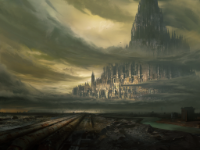
Firien, Homeworld of the Lords of Oblivion
In terms of organization, the Lords of Oblivion have traditionally more or less followed the Codex Astartes, with four Battle Companies, four Reserve Companies, and a Veteran and Scout Company, plus the usual Chapter headquarters, Librarium, and Armory personnel.

However, the Chapter has a larger number of Librarians and Scouts than normal. The specific reason for the higher than normal Librarians is not entirely known, though it is theorized that it is a byproduct of the Chapter's initiation rites, which include several rituals in which the mental strength of an aspirant is tested by the Librarians. Perhaps the extensive psychic probing unlocks latent powers in some of the aspirants' minds, or it is caused by some other effect. Whatever the reason, their presence is a welcome addition on the battlefield. Due to the existance of the Commisum Legare [see Beliefs], the Librarians play only a small role in the recording of the Chapter's deeds. Instead, they are used as advisers to command personnel, or act as secondary leaders if needed. In addition, they handle all elements of psychological warfare, and are in charge of interrogating prisoners via psychic probings, rather than using physical torture.

The Scout Company is also significantly larger than normal, due to both the success rate of worthy neophytes from Firien's population being so high, and the Chapter desiring to keep a large number of scouts ready to replace casualties more easily in the case of extensive battlefield losses, something that proved extremely valuable following the Salvation of Firien.

Within the Chapter HQ, Allerka commands an additional squad of Terminators, known as the Chosen of Allerka, his hand-picked bodyguards. Their ferociousness and skill in battle is legendary, each commanding centuries of experience in battle. They are simply the best warriors in the Chapter.

When the Chapter goes to war, the Reserve Companies are often fielded just as much as the Battle Companies, to allow their additional firepower to be put to good use, rather than simple wait for holes to appear in the Battle Companies' lines to be filled. While this is riskier, because compromised positions are harder to reinforce, it usually pays off, and was the sole reason many elements of the Chapter survived the various battles they fought on Firien.


Beliefs
The Lords of Oblivion have a similar belief system to their primogenitor Chapter, the Iron Hands, believing strength to be an important trait.

However, unlike the Iron Hands, who believe in purging weakness in any form, notably through extensive mechanical augmentation to their bodies, the Lords of Oblivion believe more in drawing upon the strength that comes from within, for, with a heart and mind of iron, nothing is impossible. Then, when a Battle-Brother loses a limb, and needs a replacement, they are that much stronger for it.

In fact, a battle decoration unique to the Lords of Oblivion is the Tabard of Fortitude, which is given to any Battle-Brother who achieves Veteran status without requiring any bionic augmentations at any point in their career. Once awarded, it is always kept, even if afterwards the Veteran requires augmentation. Each of the Chosen of Allerka has this decoration, and it is a testament to a Battle-Brother's ability to keep himself alive in combat.

The Lords of Oblivion embody the values of their homeworld, placing the good of humanity above their own personal desires. During the few times they can remain on Firien, they often speak to the populace, giving rousing speeches or encouraging citizens to do their part to ensure Firien's safety.

The Commisum Legare: In addition, the Lords of Oblivion place a strong value on records of deeds. This takes form in several ways, from the tendency of Battle-Brothers to collect trophies from defeated enemies, to inscriptions or honor markings, to the Scriptorium Oblivio, a massive tome of honor which details all of the Lords of Oblivion's campaigns in extensive detail.

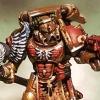
Lords of Oblivion Terminator
Following every major battle, campaign, or action, in which the Lords of Oblivion take part, every surviving Battle-Brother that partook will write their recollection of the events. This can take the form of a ballad, a narrative, a song, or other form of literary expression. Once all the stories are written, they are distributed to the other Battle-Brothers, who read over all the stories in their spare time following the event, and the Brothers vote on which story they found to be the most accurate, the most stirring, and the most well-written. Once all the votes are tallied, the chosen story is entered into the Scriptorium Oblivio, and the Battle-Brother who wrote the story is awarded the Samurai's Robe, as a mark of their skill. Due to the fact that it will often take numerous tries to "win" at this, a Battle-Brother being awarded a Samurai's Robe has become synonymous with achieving Veteran status, though obviously the two designations do not always coincide directly for a given Battle-Brother. This ritual is known as the Commisum Legare.

In this way, the Scriptorium Oblivio reads as an epic chronicle of nearly three thousand years of glorious heroism.


Gene-seed
The gene-seed of the Lords of Oblivion comes from the Iron Hands. It was believed the strength of personality noted among the Iron Hands and their Successor Chapters would be an ideal match with the honor-driven mentality of Firien's population.

There has been no evidence of mutation of destabilization during the Lords of Oblivion's existence. Their gene-seed appears to be quite stable.

The only notable divergence is a slightly higher number of Librarians within the Chapter, as well as many officers having minor psychic ability. The reason for this is unknown, whether it's a result of Firien's population, or something with Firien itself, or a result of the initiation rites of the Chapter, no one knows. In addition to this, the Lords of Oblivion have developed a particularly strong hatred towards weakness (much like the Iron Hands), especially mental weakness. Whether this hatred is a coincidence, or some sort of inherent characteristic of the Iron Hands gene-seed, none are sure, but many lean towards the latter, as other successors of the Iron Hands demonstrate similar characteristics.

In any event, there has been no case of physical mutation, and the gene-seed of the Lords of Oblivion remains as stable as they have.


Battle-Cry
"Strength and honor" is often used as a phrase of salute between Battle-Brothers. In battle, "For the Emperor and humanity!" or "For Ferrus!" are often used. Other battle-cries in the battle-language of the Lords of Oblivion are also used regularly.


Would You Like To Know More?
Author
Allerka has been a member of the Bolter & Chainsword since 2006, and is now a Lexicanium of the Librarium. He has been playing 40K and the Lords of Oblivion since 2002, and has won several Rogue Trader Tournaments in Korea.

Download the homegrown Codex: Lords of Oblivion here, or join the development discussion for it here.

View the gallery of completed Lords of Oblivion models and artwork here.

Read the blog for the Lords of Oblivion, including additional stories, here.


Print Article


Lo-Fi Version Time is now: 9th February 2010 - 02:24 PM