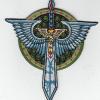
Aegnor Posted February 16, 2011 Share Posted February 16, 2011 The Celestial Dragons http://i1277.photobucket.com/albums/y484/Vulkan2013/PaperArtist_2013-03-14_23-01-27_zpse55d5ac2.jpgThe Celestial Dragons stand proudly among the champions of the Imperium. Hailing from bright Tian, they are the heirs to a culture and a philosophy that predates the Imperium itself. Like their estranged forebears, the Ultramarines, their domain is an orderly, thriving realm where humanity flourishes, albeit under strict control. Proud to the point of arrogance of their homeworld and heritage, they remain resolute that by the force of their arms and the virtue of their wisdom, they can bring the Imperium and humanity into a new golden age.OriginsThe Celestial Dragons Chapter was created as part of the Fifth Founding early in M33. Still striving to restore the numbers of marines who had helped establish the Imperium prior to the Great Heresy, the High Lords of Terra had wanted to reinforce the Candidus sector in Segmentum Ultima, which was suffering increasing intrusions by xenos greenskin and piratical elder. Tian, as one of the 500 worlds added to the pre-Heresy Ultramar, was chosen at the request of the Ultramarines who had been selected to stand up and train the new chapter.HomeworldImperial contact with Tian first occurred in the later stages of the Great Crusade, when a detachment of Ultramarines found a well-ordered, densely populated planet. Its government claimed a glorious history stretching back beyond the Age of Strife. Though the planet had significant industry, it was not a wasteland - dense factory-cities were surrounded by expanses of well-organized fields and forests, and while the rivers of the larger industrial cities were hardly pure, Tian was still a jewel compared with many of the industrialised wastelands found elsewhere in the Imperium.Unlike many lost branches of humanity, the rulers of Tian were glad to be reunited with Terra and to learn of the Emperor, and were thus spared the devastation of an enforced compliance. These rulers were a meritocratic bureaucracy that had endured since before the Age of Strife. The planet’s time-honoured system of global examinations, in which individuals proved their suitability for their desired office through exhaustive written testing of their knowledge of Tianese philosophy and the relevant practicalities, enabled Imperial iterators to efficiently spread the tenets of the Imperium across the world. Imperial historians have since suggested that the pervasive and efficient bureaucracy made it possible for the rulers of Tian to promptly identify psykers in the population and cull these mutants as threats to the orderly system of rule – in the process unwittingly protecting Tian from the worst horrors of Old Night.Tian was adopted into the burgeoning Ultramar, becoming part of the larger Imperium in the reforms that followed the Horus Heresy. Noting it connection to the Ultramarine legion, the Ultramarines suggested it as the base for one of the new Fifth Founding chapters.In the 41st millennium, Tian remains a bright jewel within the Imperium. It boasts efficient, profitable industry, but also remains self-sufficient for foodstuffs. Its people live with a degree of dignity and common purpose rarely found in the Imperium, and if the paternalistic guidance of the Dragons and their civilian appointees is somewhat stifling, it remains a better place to live than much of the Imperium.BeliefsThe beliefs and traditions of the Celestial Dragons are closely derived from the ancient culture of Tian. Moreover, the presence of the Dragons has altered the beliefs of the planet, instilling a new focus on martial activities and preparations suitable for a world that supports a chapter of the Adeptus Astartes.The rulers of Tian ascribed their regime’s extraordinary durability, and their world’s prosperity their ancient philosophy of Kar-Sheng, which has as its guiding principles the concept of filial piety and the belief that humanity can be improved through study and instruction. This philosophy suggests government by those who have shown themselves most competent, a strong respect by those in government for the needs and welfare of the people, and strong unity in the populace. The Tianese readily accepted the Emperor as the ultimate father of humanity to whom they owed their loyalty, by virtue of his demonstrated genius and accomplishment. The Celestial Dragons retain this philosophy and have become its greatest exemplars.The Dragons' belief in a mutual obligation between themselves and the citizens of the Imperium guides their execution of their duty, injecting a concern for the welfare of the common citizen. Unlike some chapters, they are strongly interested in how those they protect live their lifes, and strive to inculcate what they consider to be positive values into those populations. This includes at times correcting those acting against what they see as the common good of mankind. Under Kar-Sheng, those failing to meet their their obligations require firm but patient correction and instruction. Those who persist in failing must be excised for the overall good of the community.The marines of the Celestial Dragons are warriors first and foremost and they practice their art with a focused zeal. However, they are also expected to be scholars, understanding why they fight and how the interacting demands of honour, duty, and obligation inform how and when they fight. The warriors of the Dragons tend to display a philosophical, reflective nature, taking their duty with the utmost seriousness, but tempered with a desire to be fighting for the right reasons as well.This preparedness to judge others, and their conviction in the superiority of their philosophy and knowledge has led to accusations of a profound arrogance by their critics, who charge that they consider themselves superior to anyone not from Tian, that they view the rest of the Imperium as barbarians. There may be some basis to these charges – for their part the Dragons do belief that only the Emperor has been able to provide any real improvement to the wisdom of their ancestors. It is notable that although most Dragons have a basic understanding of Low Gothic, they refuse to speak it wherever possible, seeing it as a crude, barbaric tongue. Translators are used where possible, and all serious study, discussion and debate occurs in Tianese.Combat DoctrineThe Celestial Dragons strictly follow the doctrines of combat laid out in the mighty tome they claim was written by their founding Chapter Master, Honlung, the Kar Lung Hian, which roughly translates as “The Art of the Blade”. Under this tome, the first company acts as a Veteran elite known as the Tian Lung. The Chapter Master is known by the title of Dragon-Lord or the Golden Dragon.Since the coming of the Imperium, the routine purging of all psykers has halted, with psykers now being treated in the manner adopted in Ultramar, however the generations that this occurred has left the Tianese population with fewer psykers per capita than other planets. As such, the Dragons do have Librarians, but they are particularly rare.Although the Celestial Dragons jealously guard the Kar Lung Hien, and indeed it is unknown whether there are any surviving translations from Tianese to Gothic, more than a few critics over the millennia have pointed out the striking resemblance between this tome and the mighty Codex Astartes authored by the great primarch Roboute Guilliman. Foremost among these critics have been the Ultramarines themselves. Despite this issue, the Dragons' organisation and battle tactics remains consistent with those that are described in the Codex Astartes, and the Dragons are as diligent in studying and following their text as any Ultramarine successor is with the Codex itself.Schism with UltramarThe Dragons are steadfast in their loyalty to the Emperor himself, but otherwise continued to view much of the Imperium as rather uncultured and crude. This cultural arrogance first manifested itself in Tianese recruits under the initial supervision of the Ultramarines detachment sent to set up the chapter. Reservations regarding this trait led to an initial delay in the certification of the Dragons as ready to stand on their own. Eventually convinced that the Dragons would properly follow the tenets of the Codex Astartes, even though it had been authored by a non-Tianese, the Ultramarines departed, leaving the newly designated Chapter Master Honlung in charge.It was nearly a 1000 years before the two chapters met again. At this meeting the Ultramarines were unimpressed to discover the Dragons now apparently had no knowledge of the Codex, but instead followed an amazingly similar book allegedly authored by the now long dead Honlung. The Ultramarines charged the Dragons with disrespect of their common primarch, false pride, and dishonesty. The Dragons, with only the version of events indoctrinated into them by their chapter cult were incensed at these allegations and rejected them utterly..Since then the Dragons have been ostracised from cousinly relations with many Ultramarine successors.The Reign of BloodDuring the period known as the Reign of Blood, the always tense relationship between the Celestial Dragons and the Ecclesiarchy was irretrievably broken. The Dragons had long refused permission for the Ecclesiarchy to practice on Tian, and while members of the faith existed on the planet, they remained fearfully in shadows lest they be declared pernicious 'undesirables' to be re-educated. One of Ecclesiarch Vandire's favoured Cardinals was a man known as Leng, a rare Tianese who had abandoned his planet and instead joined the Adeptus Ministorium. Leng had long harboured ambitions to return to Tian and spread the word of the Lectitio Divinitatus. Leng's zeal to spread the faith of the God-Emperor was matched only by his conviction that Vandire was the agent of the Emperor, sent to lead the Imperium to new glories.As the conflict between Vandire and Imperial loyalists spilled into open conflict, Vandire placed Leng in charge of a sizeable Missionary fleet led by a Naval Grand Cruiser, and instructed him to spread the word in the Segmentum Ultima of Vandire as the sole interpreter of the Emperor's will. Leng, acting with predictable zealotry drove the fleet straight at Tian. The Celestial Dragons had stayed aloof from the conflict until this time, but when they refused to allow Leng's fleet to anchor over Tian, or his missionary zealots to land and start preaching, the Cardinal opened fire. Taken by surprise, the Dragons lost a Strike Cruiser and several smaller craft in the exchange. When a second Strike Cruiser was able to launch its payload of boarding torpedos off into the flagship, the tide of the battle quickly turned and the Dragons then swiftly destroyed or captured the remainder of the fleet. The Dragon Lord led the flotilla of captured zealot ships to a planet in the nearby green-skin empire in the Grishnak cluster. Addressing the prisoners over the fleet intercom, he informed them that the Emperor valued actions over words, and that he would give them the chance to achieve something useful by visiting the Emperor's wrath on the xenos below. He then had their ships landed on the planet and mined to explode soon afterwards, abandoning the missionaries to battle against countless millions of orks on the planet.Having been dragged into the war, the Dragons became one of the first Astartes chapters to become active in the conflict, striking against pro-Vandire forces across the neighbouring sectors.Since this incident the Dragon's previous attitude of barely veiled contempt for the Ministorium changed into one of open hostility. To this day, representatives of the Ecclesiarchy are forbidden on pain of death from landing on Tian. Members of the Adeptus Sororitas refuse to fight alongside the Celestial Dragons. Meanwhile, the plight of the few followers of the Lectitio Divinitatus on Tian has grown steadily more difficult as they are labelled a disruptive foreign influence spreading a poisonous cult. Members of the faith are routinely taken for re-education through indoctrination or hard labour. Despite this, a small element of the Faith has consistently survived on Tian.The Enforced Isolation of TianThe Celestial Dragons have continued to exercise their strong direction over the culture and activities of the people of Tian, displaying what some have called a paranoid determination to protect the planet from from "disruptive" external influences. This has included the Ecclesiarchy, the Inquisition as as much as possible, as well as the Administratum, traders and other agents of cultural 'impurity'. Some trade in necessary, but most off-worlders are confined to the trading port of Guang-Shan, considered by the the planet's rulers to be a wretched hive of scum and villiany.Nevertheless, human nature being what it is, there is a lucrative black market in "undesirable" imports like ranging from narcotics such as lho sticks, Obscura, off-world luxury items such as amasec, and foreign texts. Generally the Dragons entrust their civilian appointees to police their strictures. On rare occasions when it has emerged the bureaucracy has majorly failed in this duty, the Dragons have taken a direct hand in enforcing the embargo. On the most notable of these occasions, it was discovered that a neighbouring planet had subverted the Chief Mandarin along with several other members of the bureaucracy to turn a blind eye to the selling of their narcotic to the Tianese. The Dragons, painstaking in deciding when and how to act, but implacable once decided, responded emphatically. They conducted a significant purge of the bureaucracy, executing those suspected of failing in their duty. The Dragons then went a step further and took action to punish the narcotic peddlers, striking at their planet, destroying its PDF, annihilating its ruling Council of Traders and destroying its entire crop of its so called "chocolate" plants. This had the side effect of destroying the planet's economy and angering the sector's governor, who was fond of the planet's confectionary, however all protests were ignored. Relationships have remained strained, although none in the surrounding sectors have been left in any doubt with regard to how seriously the Dragons view breaches of the embargo they have established over their world.Ongoing CrusadesThe Celestial Dragons have fought against most of the enemies of mankind. Tian is close to the Grishnak Empire, a small grouping of systems under the control of a greenskin horde, and the Dragons will regularly campaign against these vermin. Efficiency in the extermination of the ork has become a point of pride for the chapter.In keeping with their philosophy of seeking to improve humanity, including by excising harmful elements from it, Dragon Lords have been particularly keen to contribute to crusades against heretics and rebels, being willing to send companies far and wide to participate in such sacred duties.Owing to their location in the Ultima sector, the Dragons have been involved in the defence against elements of the successive waves of Tyranid hive fleets that have entered the galaxy from that direction. As is typical of the Dragons, they have made a diligent study of strategies and tactics that will let them effectively defeat this new menace.Gene-seedThe Celestial Dragon geneseed was drawn from that tithed by the Ultramarines themselves, and with the careful attention of the chapter’s apothecaries, remains as pure as their fore-fathers.Unlike many worlds used as recruitment bases by Astartes, Tian is not a harsh environment that naturally breeds superior warrior stock. In typical Tianese style, the solution has been found in a combination of thorough, efficient organisation, and plenty of hard work.The planetary government has extended its concept of global examinations down to the pre-scholams attended by all children aged 4 across the planet. All these infants are tested for their physical and intellectual prowess. Those found to be potentially exceptional are streamed into specialist gymnasia where they are rigourously worked over the next 7 years. Subsequent examinations are held in the scholams of the planet, and any ‘late-bloomers’ are also brought across, although the experts have refined their testing to such a level that these constitute a very small number. The bureaucracy prides itself that not a single potential recruit for the Celestial Dragon goes unrecognised or without every assistance to reach that potential.By the time these children reach the age of 11, they have been placed on an accelerated program of study, physical training, endless testing and enhanced nutrition such as they are superior prospects. Even so, only a small fraction of those who graduate from the gymnasia are taken by the Dragons. Those who are not taken typically go on to have a role in the planetary defence force for a term, before joining the administration themselves.This program of intensive study, and formalised exams – both theoretical and practical, continues to be a prominent feature of an initiate’s life.Battle-Cry“For Tian and the Emperor!” Link to comment https://bolterandchainsword.com/topic/222563-the-celestial-dragons/ Share on other sites More sharing options...
Aegnor Posted February 16, 2011 Author Share Posted February 16, 2011 So, been having a bit of a break from thinking about my Abyss Hunters, and the basics of these guys came to me during a particularly boring management meeting a couple of weeks ago. Being mentally playing around with it for a while, and have now had a shot at getting it all down. Hopefully I've managed to incorporate some interesting ideas that obviously have a real world inspirations without over-theming or simply plonking a real world culture lock-stock in spaaaaaaaace. As always, bowling balls and spine-flails of criticism welcomed. As illustrated there, the colour scheme looks a bit Blood Angel, but that's meant to be a darker gold colour rather than a yellow, which the more recent Blangels seem to have moved away from in any case. There will also be some decidedly un-Blood Angel livery once I refine my ideas on that. Link to comment https://bolterandchainsword.com/topic/222563-the-celestial-dragons/#findComment-2660809 Share on other sites More sharing options...
NightrawenII Posted February 16, 2011 Share Posted February 16, 2011 Hmmmm... The Mechanicus eyed the mineral wealth, which included some relatively rare compounds, with avarice, and lodged a claim to be able to develop the world as a forge, citing a conveniently discovered ancient chart which suggested the planet had been settled originally from Mars. The Administratum wanted to develop the world as a source of food for the surrounding systems, and commence raising Imperial Guard regiments. The Ecclesiarchy saw billions of souls ready to be brought to the proper worship of the God-Emperor. All these factions vigorously asserted their claim to have dominion over the planet, and indeed began separately establishing headquarters and making ‘improvements’ to the planet. The people of Tian began to grow resentful of the naked greed with which their planet was being carved up. - The Governor of planet is member of Administratum and if the Administratum wants to increase the Tithe Grade, then it doesn't need to ask anyone. I dare say, the Administratum is Imperium. - Outside of Cardinal Worlds, the Ecclesiarchy doesn't own any planets. No need for "dominiom". - The Mechanicus part is a little bit tricky. Under normal circumstances, the Administratum sends the planetary tithe to Forge World for processing. Again, no need for "dominion". Eager to avoid favouring one party over the other and destablising the then still fragile Imperium, the High Lords of Terra settled on a compromise and issued an edict that none of the competitors would have the planet. Instead one of the Chapters to be created from the Ultramarine genestock in the then imminent of the Fifth Founding would take sole possession of Tian as their homeworld, and from there, protect the surrounding sector. - Astartes homeworlds are subjects of Aptus Non, zero tithe. They have charged the Dragons with disrespect of their common primarch, false pride, and straight up dishonesty. - The problem is, that these aren't the characteristics you want, when you are looking for SM candidates. over small matters like the refusal of the Dragons to adopt standard Gothic as their language, although while the Ultramarines remained, the Dragons grudgingly toed the line. - The Low gothic is language of Imperium. How do they talk with Imperials? Unsurprisingly, when the two chapters next met, the Ultramarines were most unimpressed to learn the Dragons apparently had no knowledge of the Codex, but instead followed an amazingly similar book allegedly authored by the now long dead founding Chapter Master. Their dismay turned to outrage when members of the Dragons, shown the Codex Astartes, accused Guilliman of stealing much of the text from their homeworld. - Except when the Celestial Dragons were founded in mid-M32, the Codex Astartes was here for more than thousand of years. Nice trolling on their part. Even the Imperial Fists are using the Codex for longer time. ++++ Chapter of gene codex-stealers. :P Nice work. :tu: Link to comment https://bolterandchainsword.com/topic/222563-the-celestial-dragons/#findComment-2661182 Share on other sites More sharing options...
Aegnor Posted February 16, 2011 Author Share Posted February 16, 2011 Hadn't seen the Red Templars before - it does look to be the same colour scheme. Might tweak mine a bit, but it's the Blood Angel confusion I'm more worried about given the commonality of them, vs the obscurity of the Red Templars. The heraldry and chapter badge will be totally different in any case. Nice catch though! Astartes homeworlds are subjects of Aptus Non, zero tithe. The tithe was in place before it became their homeworld, it was removed once that decision was made. Can include a reference to this in subsequent rewrites. - The Governor of planet is member of Administratum and if the Administratum wants to increase the Tithe Grade, then it doesn't need to ask anyone. I dare say, the Administratum is Imperium.- Outside of Cardinal Worlds, the Ecclesiarchy doesn't own any planets. No need for "dominiom". - The Mechanicus part is a little bit tricky. Under normal circumstances, the Administratum sends the planetary tithe to Forge World for processing. Again, no need for "dominion". I agree, in the proper functioning of the Imperium, this kind of dispute shouldn't happen. But I also think that the institutions of the Imperium don't always function as they should. During the Scouring and its aftermath in particular I'd imagine things were still in flux enough for turf wars etc to get more legs than they normally would. The Governor was dead by this stage and what Imperials remained had essentially gone native, with the traditional planetary rulers resuming control as stewards in the Emperor's name, still storing up the tithe and observing laws the Imperials had put in place. In this somewhat chaotic times, I can see ambitious reps from each faction trying to advance themselves by staking a claim to a very rich world where there was a lack of clarity as to ruling arrangements. And the nature of big bureaucracy is to try and protect and expand its turf. Does this make any sense? - The Low gothic is language of Imperium. How do they talk with Imperials? They have translators and many of the Dragons can speak a basic level of Gothic, but they find it an uncouth, crude language that they prefer to avoid if they can. - The problem is, that these aren't the characteristics you want, when you are looking for SM candidates. Well, that's what they were accused of. They have a different view obviously. Aside from their egregious instance of plagiarism and the denial they are in about that (although most brothers are honestly convinced of the truth of their claims and unaware of the parts of Imperial history that contradict them), they are a pretty upstanding, scrupulous bunch. And vanity isn't an unusual flaw for Astartes. Link to comment https://bolterandchainsword.com/topic/222563-the-celestial-dragons/#findComment-2661485 Share on other sites More sharing options...
NightrawenII Posted February 17, 2011 Share Posted February 17, 2011 Hadn't seen the Red Templars before - it does look to be the same colour scheme. Might tweak mine a bit, but it's the Blood Angel confusion I'm more worried about given the commonality of them, vs the obscurity of the Red Templars. The heraldry and chapter badge will be totally different in any case. Nice catch though! There is like hundreds of Chapters with red colour scheme. I agree, in the proper functioning of the Imperium, this kind of dispute shouldn't happen. But I also think that the institutions of the Imperium don't always function as they should. During the Scouring and its aftermath in particular I'd imagine things were still in flux enough for turf wars etc to get more legs than they normally would. The Governor was dead by this stage and what Imperials remained had essentially gone native, with the traditional planetary rulers resuming control as stewards in the Emperor's name, still storing up the tithe and observing laws the Imperials had put in place. In this somewhat chaotic times, I can see ambitious reps from each faction trying to advance themselves by staking a claim to a very rich world where there was a lack of clarity as to ruling arrangements. And the nature of big bureaucracy is to try and protect and expand its turf. Does this make any sense? I know what are you saying, but the friction is too forced and artificial in the light of normal interaction of these organisations. Well, that's what they were accused of. They have a different view obviously. By their own training cadre. These guy are here to lead and supervise the training of your marines. Link to comment https://bolterandchainsword.com/topic/222563-the-celestial-dragons/#findComment-2662012 Share on other sites More sharing options...
Aegnor Posted February 21, 2011 Author Share Posted February 21, 2011 Okay, added a looong side bar (seem keen on them today), which in combination with changes to the Beliefs section will hopefully answer some of the good points Nightrawen made re: why the training core would let these guys get away with Grand Theft: IP. Also revised the Homeworld section - which I know was already long, to again pick up on NRII's points. I wanted to retain the battle of imperialist powers exploiting and carving up wealthy ancient empire element, as well as explain why a world that would otherwise be a high tithe Imperial asset was given to a chapter of Marines. I've also added (well, am about to go back and edit in now) an extra bit I did on recruitment. Link to comment https://bolterandchainsword.com/topic/222563-the-celestial-dragons/#findComment-2666442 Share on other sites More sharing options...
Aegnor Posted February 21, 2011 Author Share Posted February 21, 2011 Recruitment bit done. ;) Link to comment https://bolterandchainsword.com/topic/222563-the-celestial-dragons/#findComment-2666453 Share on other sites More sharing options...
Ferrata Posted February 21, 2011 Share Posted February 21, 2011 This has some cool bits in and should develop into a really good chapter, but at the moment you are telling us too much stuff that doesn't affect the Chapter. Nearly the entirity of the Homeworld section is pointless in regards to the Chapter itself - no more than a paragraph should do the history of a homeworld. The rest needs to be about how the homeworld affects the Chapter - what influences them? What ideals? etc. The conflict with the Codex Astartes seems a little off as well, and I don't know if this is going to be developed or not. I think it would run smoother if the Chapter developed their own version of the Codex Astartes based on the teachings of their book because surely a book written so long ago would almost be outdated. Especially to tell them how to organise a chapter of Space Marines. Link to comment https://bolterandchainsword.com/topic/222563-the-celestial-dragons/#findComment-2666702 Share on other sites More sharing options...
Marshal Renatus Posted February 21, 2011 Share Posted February 21, 2011 Ok...so I had this 3 hours ago, and the my internet went out. Stupid Tzeentch... Some of this Ferrata hit, but I think I went more in detail. *cracks knuckles* Here we go: The Celestial Dragons stand proudly among the annals of the Imperium - This sounds a little off. Maybe they stand proudly among the pantheon of Imperial heroes, or are distinguished among the many annals of Imperial history? are guided by the wisdom of a mighty tome that sets out the manner in which they wage their wars and govern their homeworld - too blunt. Try something like “eschew the guidance of the Codex Astartes in favor of their own tenets contained in their own sanctified tome/volume/work” they can ultimately redeem their species. - Interesting concept, but where’d this come from? You never mentioned that mankind needed redeeming in the first place. As part of the founding, the High Lords of Terra had wanted to reinforce the Victorius sector in Segmentum Ultima, to ensure it was sufficiently protected, following an increase in hostile xenos activity and difficulties by existing chapters from neighbouring sectors in responding. The selection of Tian as the homeworld for the newly established chapter reflected the complexities of Imperium politics as much as it did the suitability of that planet to host a chapter. - We certainly need more on the Origins section. What kind of xenos? Eldar? Ork? Hrud? Bhargesi? What chapters couldn’t respond? And how can multiple chapters fail to cover one sector to such an extent that an entire chapter is needed to hold it? What complexities and who was involved? Strongly recommend the Octaguide for this section. The 376th Expeditionary Fleet, under the control of a detachment from the Ultramarines Legion, found a world with not only a large population of humans, but also a stable, well-ordered planet, with a government that exerted control of the majority of the planet, and which claimed to date, as an institution, back several thousands of years prior to the Age of Strife. - Too specific on the fleet. While guilty of doing the same thing…why is the UM finding it important? In my case, the UMs made the world orderly…your world is already orderly. Maybe an unknown legion…that left a penchant for penning your own written works beyond those of the Emperor and the Imperium (*cough*Wordbearer’s*cough*traitor*cough*) The rulers of Tian ascribed their regime’s extraordinary durability, and their world’s prosperity to their guiding philosophy of Dar-Sheng, which has as its guiding principle a central tenet the concepts of filial piety and that humanity can be improved through study and instruction. These profoundly meritocratic ideas had led to a system of government by those who had shown themselves most competent, a strong respect by those in government for the needs and welfare of the people, and strong unity in the populace. This world view also helped the rulers readily accept the Emperor as the ultimate father of humanity, to whom they owed their loyalty - We’ll see how this pans out but “meritocracy” and “needs and welfare of the people” don’t sound very Imperial to me, lol. More likely Dar-Sheng catches a bolt in between the eyes and the Adeptus Administratum says “Kay boys, this here is how it’s going to work, see? I’m in charge see, any of youze think otherwise say hello to my IG/SM friends here, capiche?” The regime’s time-honoured system of global examinations, in which individuals proved their merit and aptitude for their desired office by addressing exhaustive questions testing their knowledge of Dar-Sheng and the relevant practicalities, enabled the tenets of the Imperium to swiftly be adopted across the world – once established as part of the required syllabus for advancement, the Tianese dedicated themselves to mastering this knowledge. Imperial historians have subsequently hypothesised that the pervasive and efficient bureaucracy that developed under this system assisted the rulers of Tian in identifying and responding to the emergence of psykers in the population by systematically culling these mutants as infants from the populace as threats to the orderly system of rule – in the process unwittingly protecting Tian from the worst horrors of the Age of Strife. - At first blush, I was meh about this…but I think it’s actually pretty interesting. Good way of succinctly addressing integration and why you don’t have psykers saw the energy of the Great Crusade die in a welter of backside-covering, and influence-currying. - This is too jargon-ish for me. Kind of breaks the suspension of disbelief. Maybe something like “cold calculation and influence-peddling”? Instead one of the Chapters to be created from the Ultramarine genestock in the then imminent of the Fifth Founding would take sole possession of Tian as their homeworld, and from there, protect the surrounding sector. - Again, what does the UM piece add here? A DA successor would have the same effect on the factions, so it’s an irrelevant fact. Try this “…to be created in the, then imminent, Fifth Founding…” I think that fixes some of the issues with that paragraph. Very interesting…except… - In the lead in you mention all this doom and gloom about world-ending Xenos activity…and yet the people of Tian live a most amazingly cushy and ordered life. Indeed, the greatest threat they’ve ever faced, per your writing, is the pillow-fights between Administratum limp-wrists. Oooo…scary! Might want to look at that… Under Combat Doctrine - The first thing I’d do is explain the “Mastery of Strife.” It’s too confusing if you don’t, because it comes out of nowhere. Also…if the Chapter never translates it, present it in Tianese. “This ancient tome Ghuang-zhou Jiang, believed to translate loosely to ‘mastery of strife’ in High Gothic, is the creation of the Celestial Dragons earliest leadership…” Or some such. Also, the word “strife” seems off. Strife is more like unease/friction/unrest…less death/crushy/smashy. You don’t really talk about how they fight either, or I could help more with adjusting the name. I get that you’re trying to make it out like they think they wrote the “true” codex, and that’s cool…but it needs developed more. In the short term, title ideas: The Art of Death The Shadow’s Dance The Apocrypha Eversor (aka Tome of Destruction) The Nine Scrolls of the Conqueror The Fourteen Claws of the Dragon (10 companies, apothecary, chaplains, techmarines, administration/tactics/philosophy) - You need to flesh this out a lot more. For being so wildly codex aberrant, this needs to be one of the longer sections as it’s one of the more unique pieces of the chapter. The over-hanging question you have to answer is “Why?” What made them create the book, stick with it, and believe it to pre-date the Codex? All potential cool stuff…but you have to tell us. - The sidebar is interesting, but overly long. The perspective is awkward too. It’s first person, while the rest of the article is third person. You could shorten it considerably and deliver the same information. All it really says is that the original training cadre from the UMs (again, why not a successor like Invaders or Novamarines? Avoid Genesis and Black Consuls…they’d react very poorly to the Chapter cult) had reservations about the allowing the Chapter to perform its mission because of their unwillingness to embrace the Codex and Guilliman. This would also be a huge issue, FYI, and needs much explaining. See Grey Hunter Ydalir’s Blazing Sons IA for a good look at what happens when you take a leak on your primogenitors. - In the beliefs section…change who they meet from the UMs to a super-codex chapter like Genesis/Black Consuls. The resulting argument would get heated enough, maybe even physical, that the UMs would then get involved. And then you get Lord Macraggae having to weigh in. If you decide to make it physical…understand the full ramifications that entails. The last chapter that duked it out with a UM successor, the Knights of the Raven, got sent on a penitent crusade by Calgar. Not sure how one first founding Chapter Master managed to trump another (e.g. Raven Guard), but in GW’s weird Calgar/UMs=Emperor paradigm this is apparently possible. “For Tian and the Emperor!” - Love, love, love the fact that you put Tian first, lol. This really does mirror your boys well. All in all, it is a pretty solid start. Lots to refine/chop/explain, but I find myself interested in finding out more and that’s always a good thing. The Chinese dynasty flavor comes through without being a brick to the head, so also good. The color scheme is a little too red for me. I think Chinese dragon artwork and I see lots of blues, greens, reds, and golds. What you’ve got now looks a lot like a BA successor. Might try working in a different primary color and leaving that “imperial red” color for the shoulders. I also see these guys with “Tianese” kanji all over their armor and maybe even dragon art on the greaves…not sure of your photoshop skills or connections, but just images that come to mind. Hope this helps brother. Looking forward to seeing more. Link to comment https://bolterandchainsword.com/topic/222563-the-celestial-dragons/#findComment-2666750 Share on other sites More sharing options...
Aegnor Posted February 21, 2011 Author Share Posted February 21, 2011 Yeah it does. Some very solid feedback there guys, meditate on this I will [/yoda] Renatus - yeah, they'll have Chinese characters in gold on their pauldrons. Link to comment https://bolterandchainsword.com/topic/222563-the-celestial-dragons/#findComment-2666921 Share on other sites More sharing options...
Grey Hunter Ydalir Posted February 22, 2011 Share Posted February 22, 2011 See Grey Hunter Ydalir’s Blazing Sons IA for a good look at what happens when you take a leak on your primogenitors. Hey look, I was mentioned! :lol: It's true, spurning your parent chapter is not an act with few consequences. Then again, that's why I chose it, I want those consequences. Link to comment https://bolterandchainsword.com/topic/222563-the-celestial-dragons/#findComment-2667318 Share on other sites More sharing options...
Aegnor Posted February 22, 2011 Author Share Posted February 22, 2011 This has some cool bits in and should develop into a really good chapter, but at the moment you are telling us too much stuff that doesn't affect the Chapter. Nearly the entirity of the Homeworld section is pointless in regards to the Chapter itself - no more than a paragraph should do the history of a homeworld. The rest needs to be about how the homeworld affects the Chapter - what influences them? What ideals? etc. Hmmm, I've missed my aim significantly if it isn't apparent in the text that the culture/beliefs/ideals of the chapter ARE EXACTLY those of their homeworlds. Will have a look at recasting how and where I introduce those ideas. With how they fight, I'm a bit uncertain what to say here. My vision for these guys is that they are very true to the Ultras vision of following all the ideas of the codex to the letter, and hence they are flexible, all-rounders with no real weird quirks as to how they fight. How much can I say about this that won't just boil down to "they're like the Ultramarines!". Similarly, I agree there needs to be some expansion about what they've been doing in the last 8000 years, but am a bit wary about doing a list of notable engagements etc, but want to avoid a long recitation of "then they heroically smashed Waaagh Grotsplatter. Then they battled a rogue splinter of Hive Fleet Leviathan. Then they fought a renegade chapter.". Unless it's changed the chapter, who they've fought seems a pretty boring topic. They're marines, they fight whoever sticks their head above the parapet. Lots to think about. Link to comment https://bolterandchainsword.com/topic/222563-the-celestial-dragons/#findComment-2667422 Share on other sites More sharing options...
Ferrata Posted February 22, 2011 Share Posted February 22, 2011 Hmmm, I've missed my aim significantly if it isn't apparent in the text that the culture/beliefs/ideals of the chapter ARE EXACTLY those of their homeworlds. Will have a look at recasting how and where I introduce those ideas. I understood that bit, however a lot of the homeworld section is talking about the homeworld's history - which doesn't affect the chapter. The following is about what we need to take from the HW section: The rulers of Tian ascribed their regime’s extraordinary durability, and their world’s prosperity to their guiding philosophy of Dar-Sheng, which has as its guiding principle a central tenet the concepts of filial piety and that humanity can be improved through study and instruction. These profoundly meritocratic ideas had led to a system of government by those who had shown themselves most competent, a strong respect by those in government for the needs and welfare of the people, and strong unity in the populace. This world view also helped the rulers readily accept the Emperor as the ultimate father of humanity, to whom they owed their loyalty. The rest of it has no affect on the chapter. Unless they have a strong dislike for certain aspects of the Imperium, in which it could be easily written as "Due to the political shifting, and sometimes outright conflict, between different parties of the Imperium, the people of Tian have a strong mistrust of the Adminstratium." Link to comment https://bolterandchainsword.com/topic/222563-the-celestial-dragons/#findComment-2667537 Share on other sites More sharing options...
Aegnor Posted February 22, 2011 Author Share Posted February 22, 2011 The color scheme is a little too red for me. I think Chinese dragon artwork and I see lots of blues, greens, reds, and golds. What you’ve got now looks a lot like a BA successor. Might try working in a different primary color and leaving that “imperial red” color for the shoulders. I also see these guys with “Tianese” kanji all over their armor and maybe even dragon art on the greaves…not sure of your photoshop skills or connections, but just images that come to mind. Was pretty adamant on the all-red scheme, if only because of my desire for a pretty basic paint scheme I was confident I could execute. But your line about "blues, greens, reds, and golds" made me think about that kind of artwork, and I've got an alternative I think is not bad actually: or as a slight variation of the above: Your suggestion about the calligraphy and hints of dragon imagery in gold across different bits of the armour is something I was thinking about already and will do, but my skillz in this regard on the SM Painter are non-existant, so maybe just try to imagine that. Do people like this scheme? Link to comment https://bolterandchainsword.com/topic/222563-the-celestial-dragons/#findComment-2667637 Share on other sites More sharing options...
Marshal Renatus Posted February 22, 2011 Share Posted February 22, 2011 I was thinking more like this... http://img.photobucket.com/albums/v15/StormShadow98/smCA493BY2.jpg This screams, "Hey! I'm a dragon! A Chinese dragon!" Link to comment https://bolterandchainsword.com/topic/222563-the-celestial-dragons/#findComment-2667867 Share on other sites More sharing options...
Aegnor Posted February 22, 2011 Author Share Posted February 22, 2011 I like the scheme, but honestly it's a bit too close to my existing Salamanders' scheme. I want to avoid a predominantly green scheme if I can (need some variety! :tu:) Link to comment https://bolterandchainsword.com/topic/222563-the-celestial-dragons/#findComment-2668182 Share on other sites More sharing options...
Marshal Renatus Posted February 22, 2011 Share Posted February 22, 2011 Totally your call. The green should be a jade/leaf/bamboo green color though...not much chance of them being chanced for Sallies...Mantis Warriors, maybe, lol. Link to comment https://bolterandchainsword.com/topic/222563-the-celestial-dragons/#findComment-2668185 Share on other sites More sharing options...
Captain Juan Juarez Posted February 22, 2011 Share Posted February 22, 2011 Your original scheme features eight, or nine - I forgot in the ten seconds it took to write the first part of the sentence, and that is waaaaaaaay to much. I'd suggest going for either a lighter gree or just ignoring the scheme as a way to tie them to the whole dragon thing.. It isn't imperative. Link to comment https://bolterandchainsword.com/topic/222563-the-celestial-dragons/#findComment-2668188 Share on other sites More sharing options...
Aegnor Posted April 10, 2011 Author Share Posted April 10, 2011 Hmmm, finally having a look at this again after being confined to posting via iPhone for the last couple of months after my computer crapped itself. If anyone hasn't tried it, I'd actually suggest a six week hiatus from your IA as a really good way to get some perspective on it. Will be revising significantly I think - one thing that has particularly struck me now reading this thread again is how much more "useful" I'm finding the feedback provided than I did at the time it was provided. Nothing to do with the feedback - it was always actually really good, but at the time, I was too caught up in what I'd written to really appreciate it. The step back and time away has certainly helped in that regard. So thanks again guys. In particular, I'd like to apologise for my multi-coloured paint scheme suggestion - what was I thinking? :D EDIT: VERSION 3 now up. Main focus was on cutting down some of my wordier parts, in particular the homeworld section which definitely was too long. Link to comment https://bolterandchainsword.com/topic/222563-the-celestial-dragons/#findComment-2719112 Share on other sites More sharing options...
Aegnor Posted April 11, 2011 Author Share Posted April 11, 2011 Ok, I've had a second crack at the rewrite I started last night, so version 3.5 is up. As per the sub-heading, I've cut a fair bit out of the Homeworld section, and either tossed it or reworked it and put it into an expanded Beliefs section. Hopefully this does a better job of giving you the audience a better feel for who this chapter are and what they are like. Thanks as always for feedback to this point - would be grateful for anything further anyone felt like adding! Got a completely different colour scheme in mind as well: The chapter badge would be in gold on the shoulders, and there would be (painting prowess willing) some Chinese dragon "tattoo" markings on the armour - maybe in a different company for each company. The light blue would be more bluey-silver, rather than the Space Wolf blue-grey the painter is showing. Link to comment https://bolterandchainsword.com/topic/222563-the-celestial-dragons/#findComment-2720078 Share on other sites More sharing options...
Ecritter Posted April 12, 2011 Share Posted April 12, 2011 One thing I must ask, what makes Tian a suitable planet for recruiting Space Marines? I think as you have it set up, political reasons would be cause to put a Guard Regiment there, but not a SM Chapter. Link to comment https://bolterandchainsword.com/topic/222563-the-celestial-dragons/#findComment-2721382 Share on other sites More sharing options...
Aegnor Posted April 12, 2011 Author Share Posted April 12, 2011 At the moment, probably not much :). This was the part of the story I have been struggling with - unlike the founding legions, the answer can't be "because a Primarch landed there" but I like Tian as it is and don't want to turn it into the stereotypical deathworld. I had the clash between competing parts of the Imperial apparatus as the reason, but that wasn't especially well received. Hmmmmmmm..... Open to suggestions, otherwise I'll keep thinking on it. Link to comment https://bolterandchainsword.com/topic/222563-the-celestial-dragons/#findComment-2721404 Share on other sites More sharing options...
Ecritter Posted April 12, 2011 Share Posted April 12, 2011 I'll think on it for a day or so, maybe I can help. EDIT: Only problem is right now as written, Tian is too 'nice' a world to make suitable recruits. It may need changed at least a bit. EDIT EDIT: Question, what about Tian do you REALLY want to keep and what can be changed? Link to comment https://bolterandchainsword.com/topic/222563-the-celestial-dragons/#findComment-2721412 Share on other sites More sharing options...
Aegnor Posted April 26, 2011 Author Share Posted April 26, 2011 Was thinking about eCritter's point a bit more and decided that he is right. My vision of Tian was of an orderly, prosperous world of plenty that had survived the Long Night intact. For a human world outside of the Imperium, this either means (as I see it) that they somehow avoided the depredations of xenos and Chaos, or retain high-tech weaponry etc with which they've fought it off, or they've allied with some xenos faction that hasn't wiped them out and has instead protected them. None of those appeal for my guys, but I'd gone for the "they were just fortunate and avoided any hostiles". I definitely don't want it to be a deathworld, nor a world that is suffering a major xenos invasion just as the Imperium arrive to conveniently save them. Maybe there could be some kind of nasty indigenous xenos (hmmm... can something be both indigenous AND xenos or is that an oxymoron?) that the human settlers had driven back into one area of the world, and millenia of constant vigilance and battle on the line of that containment zone has gone on, as the price to be paid by the defenders for the continued safety and prosperity of the rest of the planet? Nothing stupid that would be unbelievable for isolated non-Imperials to keep cornered, but also something they couldn't finish off themselves until the Imperium arrived. Something with the vibe of (but not necessarily a similar form to) the border forts in Raymond E. Feist's Midkemia, or G.R.R. Martin's Westeros that protect the rest of the continent from Moredhel and Others respectively, in that young men are sent to spend some time doing their duty their and get some "seasoning" before returning to their normal lives... Link to comment https://bolterandchainsword.com/topic/222563-the-celestial-dragons/#findComment-2737489 Share on other sites More sharing options...
Aegnor Posted March 13, 2013 Author Share Posted March 13, 2013 Have done an update after a long lay off for these guys. Thanks to Marshall Renatus who ages ago suggested an alternative colour scheme that was really good but which I didn't like at the time because I was keen to avoid a green scheme (Salamanders, Dark Angels, a third green army seemed a bit much). That said, it was much better than any of the alternatives, including the original option, so I've adopted it. Last time, the feedback was that it was too focused on the homeworld, and not enough on the chapter. I've cut some parts right back, done away with the awkward "colonial battle over exploiting the planet" theme, and redrafted a couple other parts to make the points contained more directly related to the chapter. As always, bowling balls of criticism welcome. Link to comment https://bolterandchainsword.com/topic/222563-the-celestial-dragons/#findComment-3326971 Share on other sites More sharing options...

Recommended Posts
Archived
This topic is now archived and is closed to further replies.